

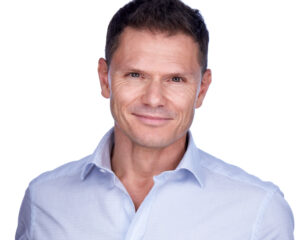
Tell us more about Avrion Therapeutics and why you decided to found it?
Avrion Therapeutics has been founded based on more than ten years of research at the Swiss Federal Institute of Technology (EPFL) in Lausanne, Switzerland, in the labs of Dr. Bernard Schneider, Prof. Patrick Aebischer, former President of EPFL, and Prof. Brian McCabe.
This spin-off is based on IP and discoveries in the field of precision gene therapies for neurogenerative disorders.
Our objective is to tackle genetically defined neurogenerative disorders that can be corrected with a gene therapy approach. What makes us unique is our gene therapy platform which allows us to selectively target specific cell types within the central nervous system, to maximize efficacy of the treatment while reducing the risks of side effects.
There are today 2 drugs on the market which bring only marginal benefits to the ALS patients, and no cure. We hope that with our precision gene therapy approach, we will be able to bring transformational solutions to ALS patients.
What does the name Avrion mean?
Avrion comes from the Greek word – “of tomorrow”, as our company aspires to deliver therapies of tomorrow.
While gene therapy solutions represented a new therapeutic modality patients hoped for since several decades, today gene therapy has become a reality with several disruptive products on the market, and many more in clinical development. Some forms of blindness can be corrected today by gene therapy, as well as other life-threatening genetic disorders.
There is a big medical need for therapies addressing neurodegenerative disorders. The ageing population is growing and with this, also the number of cases of patients affected by neurodegenerative diseases, like Parkinson’s disease, etc.
We decided to position ourselves first in a rare neurodegenerative disorder called Amyotrophic Lateral Sclerosis (ALS) due to the absence of cure for this deadly disease, and the possibility to reach rapidly proof of clinical efficacy in ALS patients.
In ALS, the death of motor neurons leads to progressive paralysis of patients, who end up literally “prisoners of their own body”, while perfectly conscious.
There are today 2 drugs on the market which bring only marginal benefits to the ALS patients, and no cure. We hope that with our precision gene therapy approach, we will be able to bring transformational solutions to ALS patients.
Where are you now?
We have completed a solid proof of concept in rodent models and are preparing studies in primates to determine the biodistribution, safety and target engagement of our clinical candidate product AVR-001. This is on the critical path to then engage into GMP manufacturing and preparing for the clinics.
What drives me is the idea that we might be able to bring to patients transformational treatments with the potential to be one-off solutions, administered once for long lasting/permanent effects. For me this is a game changer.
What does a typical day look like for you, if there is one?
We are a very young company in its Seed phase, Avrion Therapeutics has been incorporated in August 2020. Everything has to be put in place, and we are getting there. Most importantly you have to find the financial resources to launch development activities to reach the next value inflection points.
It is a very exciting and thrilling time as a CEO. Some of Avrion Therapeutics’ co-founders have known each other for decades before founding the company, and this creates a special mindset and commitment.
As CEO, I am embracing uncertainty every day. From an investors’ standpoint, we are today lucky to have discussions ongoing with private investors/business angels for the Seed phase, while at the same time we are preparing the ground for discussions with institutional investors for potential later stages of financing.
As Avrion Therapeutics is a platform company, we have been able to gain attraction at some recent partnering meetings. Indeed our gene therapy platform could be deployed in Parkinson’s and Alzheimer’s disease, as well as other neurodegenerative disorders.
A typical day involves nurturing long-term discussions with potential VCs and pharma partners, while at the same time fulfilling the operational needs of a Seed phase start-up company.
We are also trying to generate value with limited resources and being creative on how to access non-dilutive funding for immediate needs.
Can you share more on your fundraising activities?
We are aiming at raising CHF 4mn in two tranches (A & B) for our Seed round, for which we have an interim closing this week. We will extend our Seed A round till end of February as we have important parties currently in due diligence.
We launched our first fundraising during the second peak of COVID-19, the worst moment you can think of. Despite this, we have been successful and attracted investors – including, former-pharma executives/entrepreneurs, knowledgeable about biotech, and able to understand our value proposition.
It’s excellent for us to have former pharma executives and biotech entrepreneurs as investors, as they validate through their due diligence that the technology and the company is solid.
What drives you?
I have developed small molecule drugs in different roles in different companies previously, and I think that we have a momentum now with gene therapy.
What drives me is the idea that we might be able to bring to patients transformational treatments with the potential to be one-off solutions, administered once for long lasting/permanent effects. For me this is a game changer.
The field of gene therapy has gone through a bumpy road over 2 decades with trials that have unfortunately halted gene therapy clinical development for quite some time.
The hurdles that people faced decades ago have been circumvented with the introduction of Adeno-Associated Virus (AAV) vectors. At Avrion, we are lucky to have as co-founder and Chief Development Officer, Dr. Harald Petry, former CSO at uniQure. Harald has already brought an AAV-based gene therapy product to the market (Glybera).
AAV are harmless for humans and are the best gene therapy vectors you can think of today. At Avrion we use an AAV vector to deliver innovative therapeutic transgenes to neurons and astrocytes (two specific cell types within the CNS) to treat specific forms of ALS..
When you create a venture, you need two things: an innovative project and a highly committed team.
Have you always known you would be an entrepreneur?
I have realized it during my executive MBA time at HEC Lausanne. Since then, I co-founded another company before Avrion, and I’ve been involved in a series of ventures, as this is the environment where I’m at my best.
You left a career in R&D and drug development in favor of an entrepreneurial environment. Why?
When operating within a lean organization and with a strong team that works well together, you can achieve much more and faster than in a bigger organization, because the decision-making process is faster.
You address topics as soon as they emerge, you solve issues and crises on the spot. If you have the right team as I had in my last company, and now have in my current venture, you have the power of making things happen, and this is incredible to me.
As a co-Founder of two biotechs, can you share some learnings you’ve had?
When you create a venture, you need two things. The most important is an innovative project, together with a highly committed team. Both are extremely important. It is also important that at the level of the team, you cover the key expertise needed to move things forward rapidly and efficiently.
The other is to have a network that allows you to build a story around your value proposition. A startup is a story. You also need to be able to create a brand representing the values of your company.
With Avrion Therapeutics, we have been able to put together a unique team. We have a blend of academic excellence, medical expertise in the field of ALS and neurogenerative diseases, pharma development and gene therapy. Two of our co-founders have been/are involved in clinical development of gene therapy products.
The academic co-founders have been developing the technology from inception for the past ten years.
What is your view on failure and can YOU share an experience oN failure?
I have been involved for some time in a medtech company. This venture represents an example of an innovative technology developed in a company which was poorly managed and therefore failed, as the academic founder refused to delegate.
In my opinion one of the drivers of successful ventures is when the inventors of a technology or an asset understand what their domain of expertise is, and can rely and trust others’ expertise for other aspects of company growth and management.